For many social VR creators, the question right now is not only where to hang out next. It is where to keep building, playing, and turning ideas into worlds people can share.
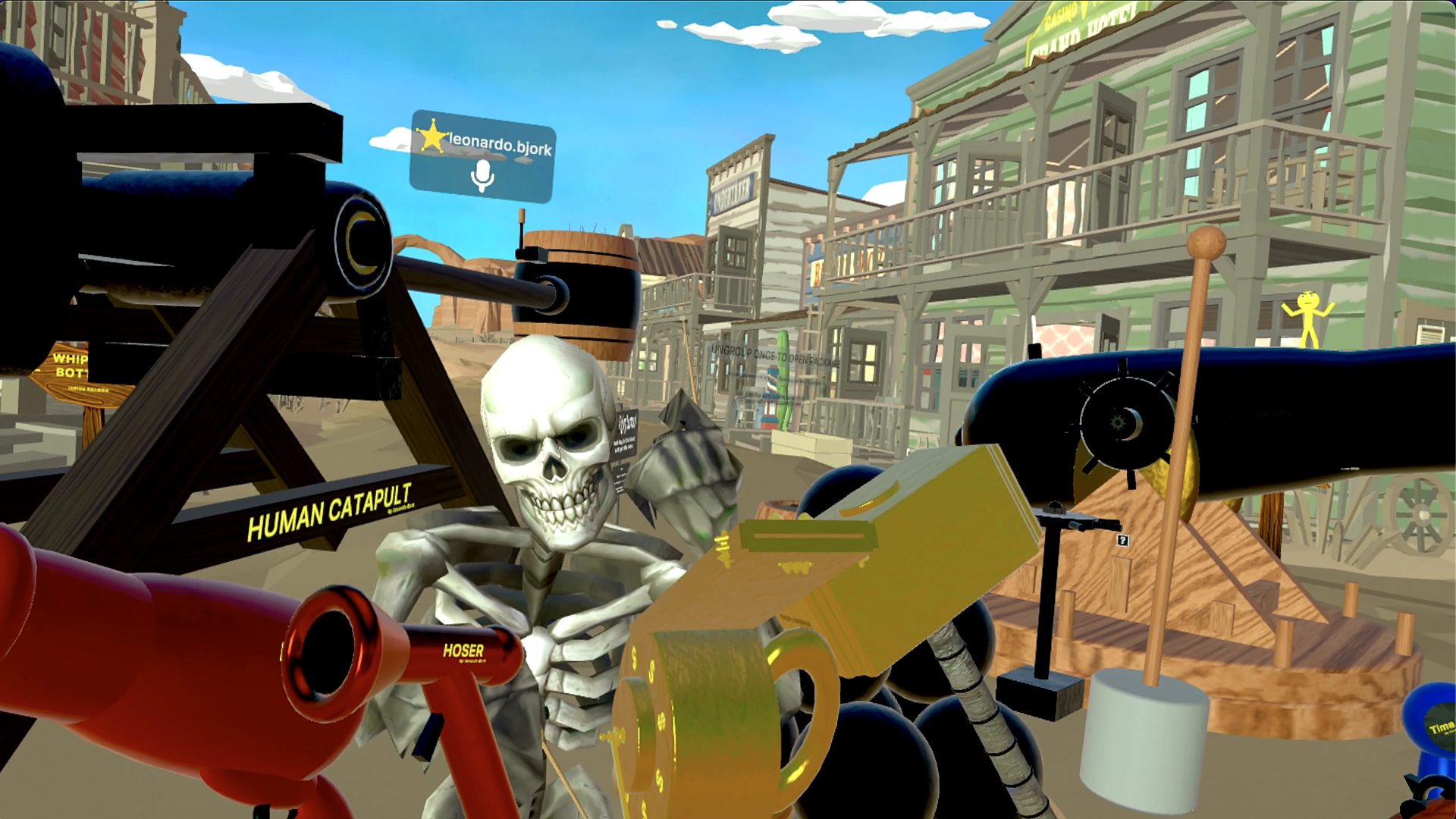
That is why we wanted to introduce Tangent, a.k.a. Leonardo Björk, instantly recognizable to many PatchWorld regulars as the quietly inventive skeleton avatar always building something unexpected somewhere in the world.
Despite showing up as a skeleton, Leonardo is one of those creators who makes PatchWorld feel alive. He builds toys, vehicles, musical machines, playful environments, bottle-shooting games, rideable trains, remote-controlled UFOs, toy weapons like hose guns, spear guns, punching gloves, human catapults, interactive bombs that throw players and objects around, stereoscopic spyglasses, lottery machines, eye-makers, and so many strange toys that feel somewhere between a garage invention, an amusement park ride, and a cabinet of interactive curiosities.
You can browse his published devices and worlds in the PatchWorld Portal.
Start with this tour of Plink Town, where Leonardo shows the rideable train, the steam engine, the western houses, the saloon games, and the playful surprises he built into the town:
And here is one of his remote-controlled UFO experiments, where the low-key humor is part of the design: the goal is to abduct cows with a tractor beam, then fly them around an idyllic little pasture while they moo:
He is not a professional game designer. He is not a musician. He is, very simply, a builder and tinkerer at heart.
And PatchWorld became his workshop without walls.
A Builder Before VR
Leonardo discovered PatchWorld in spring 2023, almost by chance.
“I thought it would hold my interest for a little while, but it was always an adventure that just keeps going.”
A naturally quiet and shy person, Leonardo was surprised by how easily he connected with others in PatchWorld. The openness of the PatchXR team and the community made it easy to form friendships that, as he puts it, seem to have grown “for years already,” even though time has flown by.
Long before he entered VR, Leonardo was already a tinkerer. As a kid, he built clubhouses, tree houses, go-karts, custom bikes, and anything else that could become a project. As an adult, he worked in mechanics and construction, often designing his own tools when a job needed something specific.
For three years, he also worked as a rides mechanic at an amusement park, work he loved.
That detail explains a lot. Leonardo’s PatchWorld creations often have the logic of rides and physical machines. They are not just scenes to look at. They are things you can operate, test, open, drive, trigger, copy, or take apart. He also takes real care in documenting, tagging, and organizing the pieces, so other people can understand how they were made and rebuild them in their own way.
Other creators often recognize his work before checking the author. Hanumanatee, another PatchWorld creator, describes Leonardo’s projects as clean, well laid-out, and instantly recognizable:
“He makes tools that help make other tools. Toys to make other toys.”
When PatchWorld Became a Workshop
At one point, Leonardo told us something that stayed with us: PatchWorld had, in a way, replaced his physical workshop.
“I miss having my own workshop at home. Where I live now I do not have my own space for such a thing.”
Over time, space became limited, and his health made physical construction harder.
PatchWorld gave something back.
“PatchWorld has given me that feeling back that I used to get while working in my own workshop, but with no real physical strain or the need for huge physical space.”
That is one of the quiet powers of virtual world building. A creator can build things that would be too big, too expensive, too dangerous, or too physically demanding to make in the real world. In PatchWorld, there is no store run for equipment, no wasted material, and very little fear of ruining the whole experiment. You can spawn blocks, copy and paste them, duplicate a complete system, change a few parameters, save variations, and keep playing until the idea starts to work. The workshop can be infinite. The machine can become the world.
A Place to Build Working Ideas
When Leonardo first opened PatchWorld, he thought it was mostly about DJ-style music and MIDI.
That changed quickly.
“It didn’t take long before I realized it was a whole lot more than that.”
PatchWorld can look overwhelming at first, especially when you open a device and see how many blocks are inside. But the secret, Leonardo says, is to start small.
“If you take on small tasks at first, just to figure out how to use the blocks and how they work together, you’re suddenly building some really cool functional things.”
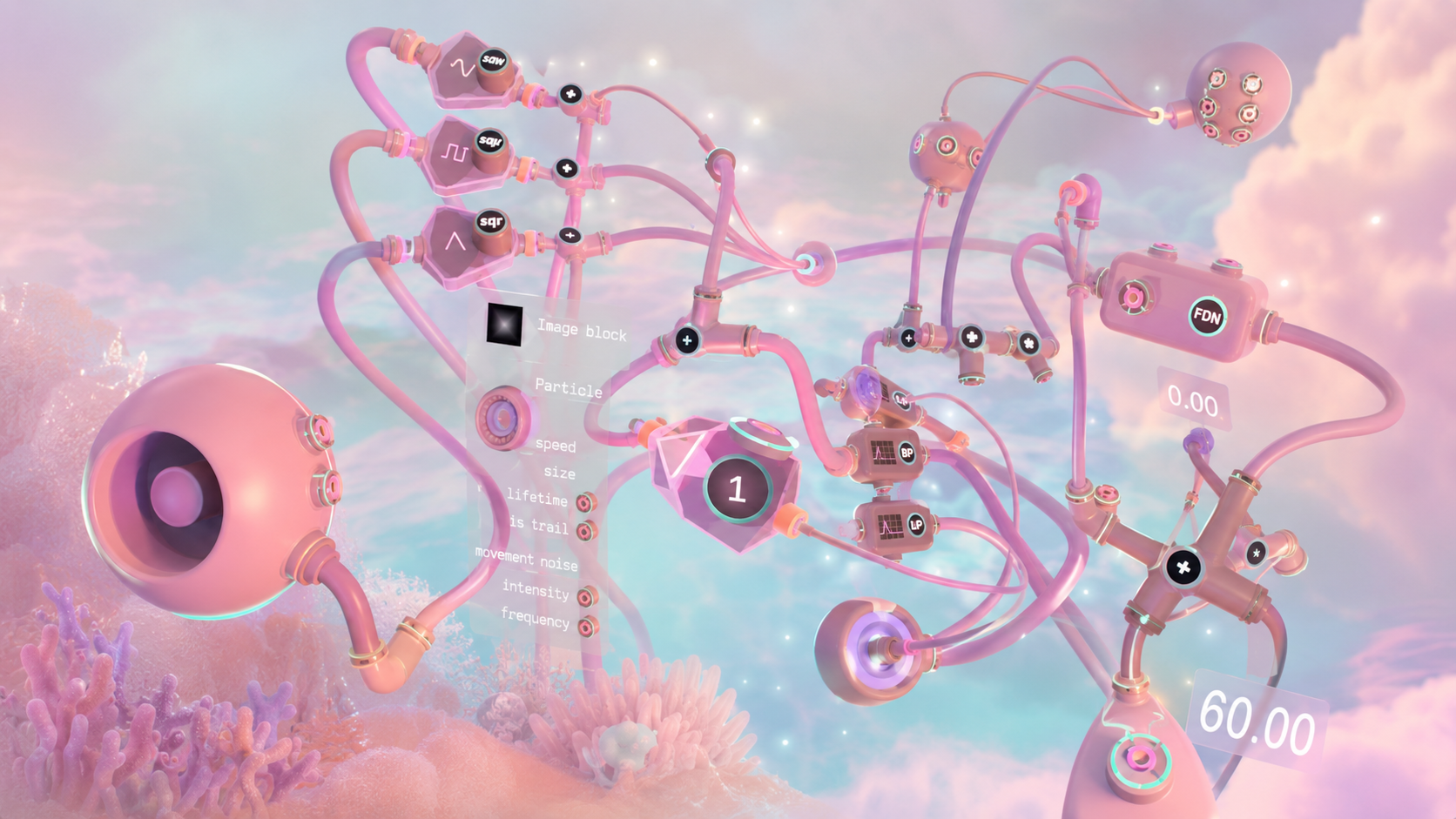
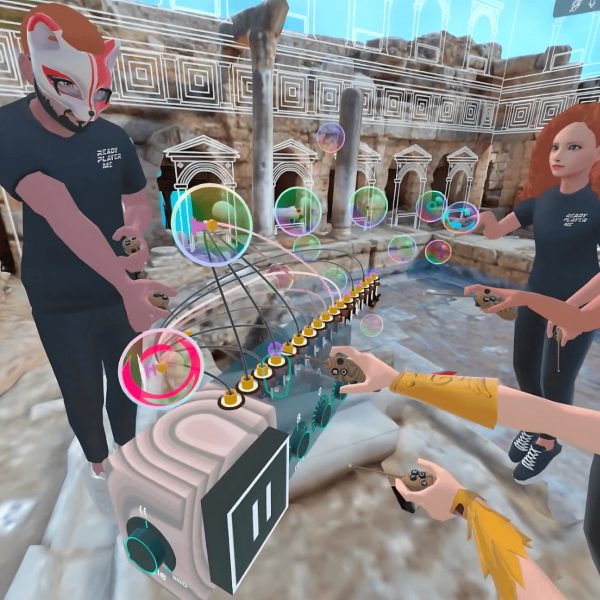
That is the heart of PatchWorld’s creation system: modular blocks connected directly inside 3D space, controlling sound, visuals, logic, physics, interaction, vehicles, gameplay systems, and world behavior. For someone like Leonardo, it is a place to turn ideas into working models that can be played with, opened up, copied, adapted, and used by other people.
Plink Town and Worlds as Rides
One of Leonardo’s most iconic worlds is Plink Town, a western-inspired playground built around several shooting games, playful systems, and a rideable train.
The name comes from “plinking,” a word for informal target practice, like shooting bottles for fun. Leonardo began by building small games just to see if he could: bottle shooting, Dizzy Ducks, Ping Ball, Hatchet Throw, and other western-style challenges. Then he wanted somewhere to put them. He found a western town model, noticed it had train tracks, and naturally wondered whether he could build an old steam engine, with its own procedural audio, that actually rode on them.
So he did.
He learned from another creator’s physics world, built an old steam engine, and turned the environment into something that feels like a small theme park in VR. His hope was that Plink Town could keep growing as a hub, with empty saloons and western spaces filled by more games, or linked to games made by other creators.
This is the pleasure of building an interactive VR world: making a place that people can play with together, not only look at.
Leonardo does not treat his worlds as precious objects.
“Pretty much all my stuff was just meant to be used by others however they wanted.”
That attitude matters. A good user-generated world does not always end with the original creator. Sometimes the best thing a world can do is invite someone else to copy it, remix it, or build the next impossible thing.
Inventions Hidden Inside Tiny Objects
Leonardo also builds musical systems, even though he insists he is not a musician. As a child, lessons and instruments were not available to him. Later, he collected instruments and experimented, but never had the time to study formally. So he built his own workarounds in PatchWorld.
Sometimes that workaround looks mechanical. Knuckle Stick, an automatic hit machine, uses a drumstick that bends in the middle on a hinge, with parameters for force and speed that change the sound. Duplicate enough of them, tune each one differently, and it starts to feel like a strange PatchWorld drum circle, built out of little machines.
My personal favorite may be The Grinder, a cute little music box that makes a monkey dance when you turn the crank. From the outside, it is charming and simple. But when you open The Grinder in edit mode, it feels like opening the Matrix of sound design: step-sequenced signals, gates, note triggers, animation, and a whole complex soundscape hidden inside a tiny object.
Here is the same device opened up, revealing the patch inside:
And here is one of his lottery machines, another example of that playful-machine energy:
He also made a device that lets him load an image of sheet music and translate notes into MIDI values one by one, then use them to build sequenced performances inside PatchWorld.
Some of these devices become PP Tape, a portable programmable sequence that looks like an old cassette tape from the outside. Plug it into a sound generator, chain it with others, and it can play back a whole composition. Open it up, and it contains an enormous sequencer system.
“It’s a tiny device on the outside, but some of them that have full sized music scores in them are quite huge if you open them. Compared to real life, some of them could probably be a quarter mile long.”
You can see that playful musical engineering in this Halloween Special world visit, where Actiondyne and Bublick explore one of Leonardo’s worlds with pumpkin characters playing a familiar spooky theme on cello, and talk about the cassette-style music systems behind it:
That is a very PatchWorld kind of invention: a small, casual-looking object that opens into a giant complex machine. A toy from the outside, a huge system of wires, logic, and engineering in the guts.
Learning by Opening Things Up
Leonardo’s way of learning is direct: find something interesting, open it, study it, and ask for help when needed.
If a device does something he wants to understand, he saves it, buys it with Vibz if it is for sale, or looks for something similar. Then he opens it in edit mode to see how it works.
When he gets stuck, he asks the community.
Todd’s weekly workshops and the PatchWorld Discord have been important parts of that process. One project leads to a discovery, which leads to another project, which leads to another problem to solve.
That loop is exactly what makes PatchWorld feel like a living maker space.
Todd, who hosts many of those weekly workshops, sees Leonardo as one of the people who quietly stretched what PatchWorld could do:
“Leonardo Björk started on PatchWorld doing things people hadn’t even considered. When he encountered barriers to his imagination, he would build workarounds in the app that turned into devices that were instant classics. He’s made player pianos, haptic devices that allow deaf users to create rhythmic sequences, puppets that perform, dance, and show emotion, and has helped make the whole platform easier to use and more fun to experiment with. I couldn’t fathom my VR experience without his expertise, and he doesn’t ever seem to appreciate his own genius. So I’ll have to do it for him. Long live our resident skeleton!”
A Place for Playful Builders
When Leonardo tries to explain PatchWorld to someone who has never seen it, he says it is hard to do it justice without experiencing it.
But he tries anyway.
“If you like creating things of any sort, this is a great place to check out. Build working models of things, build musical instruments, build audio control systems, create music, build hangouts for you and your friends, create animations, build things you can ride or drive around in your VR world.”
That sentence could almost be a welcome note for social VR creators looking for a new creative playground. PatchWorld has its own culture, tools, and music-and-sound DNA, but if what you love is building playful things with other people, Leonardo’s work shows why it may be worth exploring.
What He Hopes People Feel
When people encounter one of Leonardo’s worlds, he does not only hope they enjoy it. He hopes it makes them want to build.
“I hope it’s interesting enough for someone to think, hey, I want to try doing that.”
That may be the best definition of a good creator tool: it does not only impress people, it invites them in.
For Leonardo, PatchWorld is a place to keep making, even when a physical workshop is no longer easy to access. For the community, his creations are reminders of what happens when playful invention, patience, generosity, and strange ideas meet inside a shared virtual world.
A train on a western track. A bottle-shooting game. A musical cassette tape longer than a building. A flying UFO. Toy weapons, punching gloves, and human catapults. A device someone else can open, copy, remix, and learn from.
If you are a social VR builder, educator, artist, game-maker, or curious inventor looking for a place to keep building, PatchWorld is open.