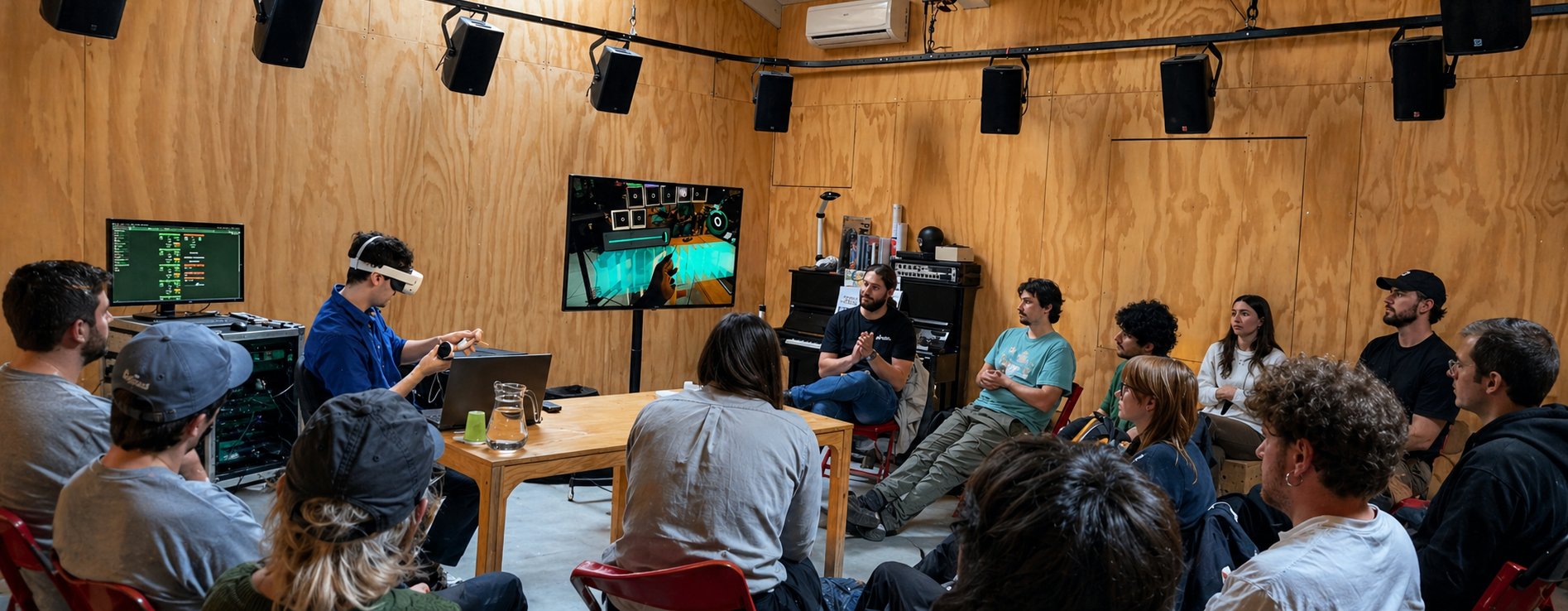
On April 18–19, 2026, PASE in Venice hosted Miller Puckette – An electronic music repertory in Pure Data, a two-day programme organised in collaboration with SaMPL, the C. Pollini Conservatory of Padua, and the Venice Conservatory. The sessions focused on electronic music practice through Pure Data, including patch exploration, real-time analysis and resynthesis, and discussion around participants’ own projects in contemporary electronic music.
On the second day, Gad Baruch Hinkis, aka DJ Patchy, co-founder of PatchXR, presented PatchWorld through a talk titled: Patching Musical Worlds – how we used the concept of node-based audio programming into a new, expressive social medium for real-time music collaboration.
The presentation was also placed in dialogue with the work of composer, performer, and researcher Enrico Benato, whose project AuraSpace explores how PatchWorld and Pure Data can be used together to build new musical instruments and spatial performance environments in VR and AR.
For us, this context was especially meaningful. Pure Data was one of the main inspirations behind PatchWorld, not only as a software reference, but as part of a wider culture of modular thinking, artist-built systems, open experimentation, and the constant reinvention of musical interaction.
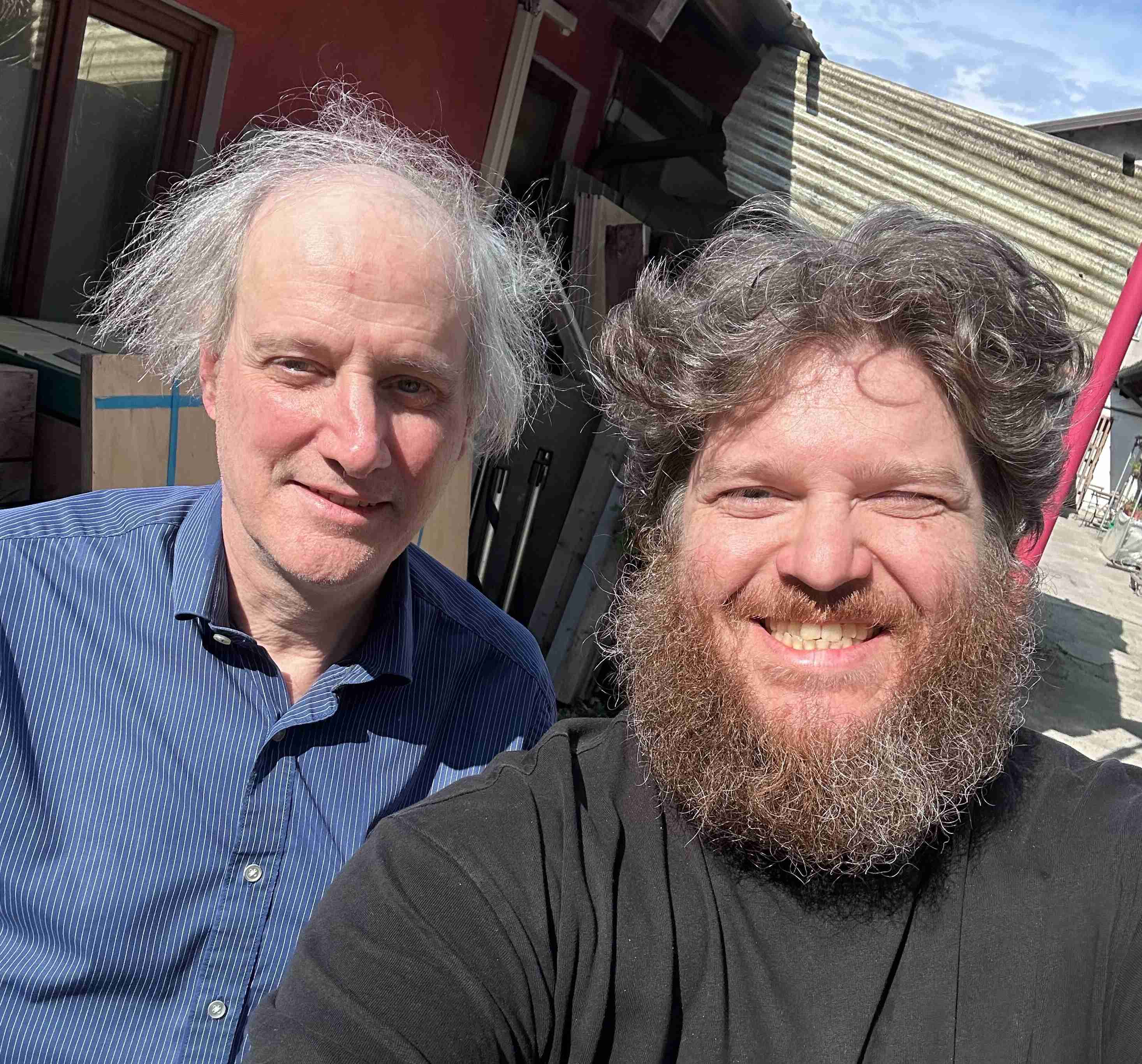
Pure Data was developed by Miller Puckette in the 1990s as a visual programming language for interactive computer music and multimedia works. It helped establish a way of thinking where music could be built from relationships between signals, events, logic, behaviours, and interfaces — not only composed on a timeline or performed through fixed instruments.
PatchWorld comes from that lineage, but moves it into another medium.
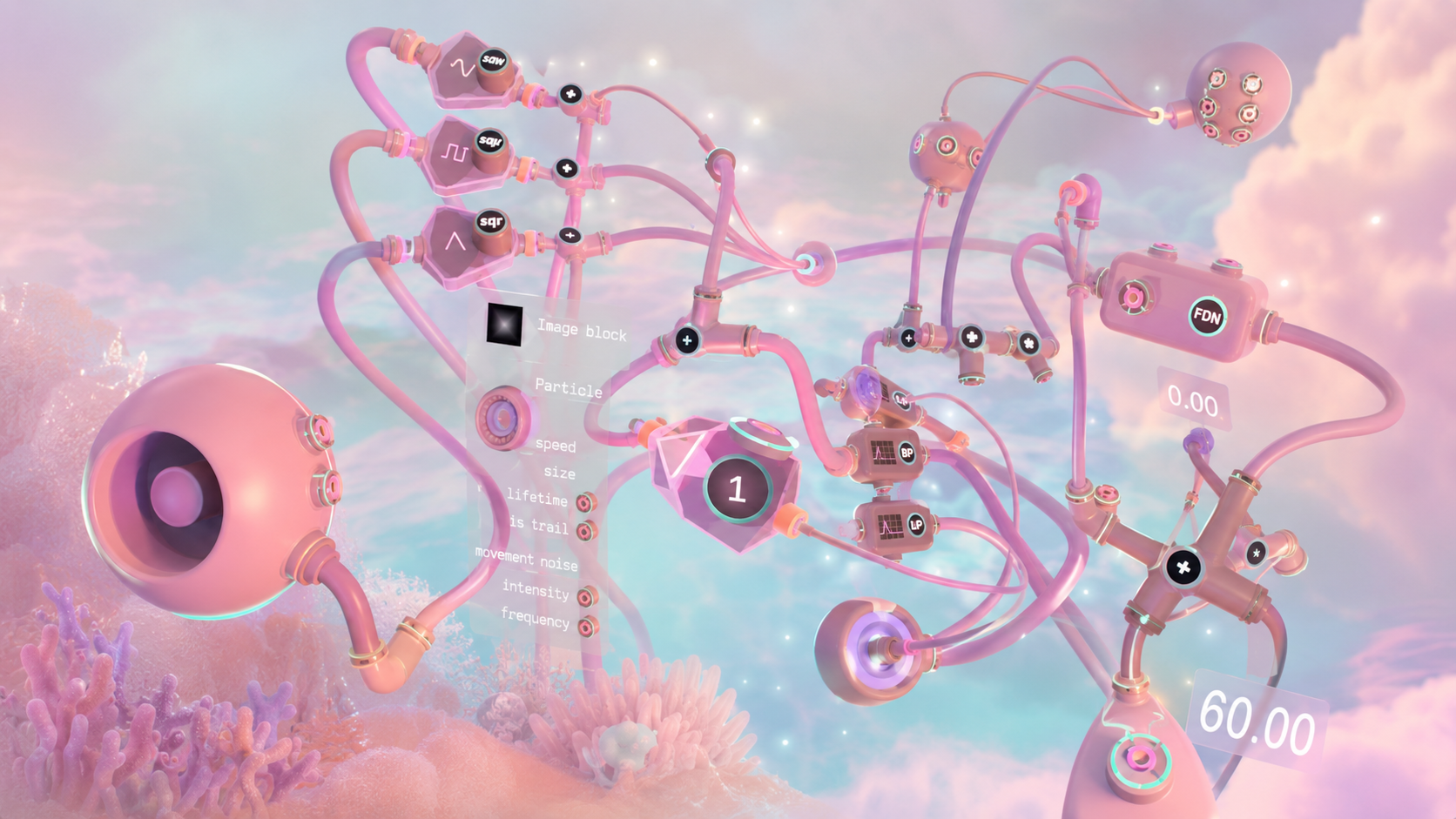
PatchWorld is also a visual programming environment, but one built around a 3D paradigm opened by immersive technology: VR, mixed reality, embodied interaction, physics, and real-time social creation. Presenting it in a context centered around Miller Puckette and Pure Data created an opportunity to bring PatchWorld into dialogue with the wider ecosystem of modular, generative, and experimental electronic music tools.
As Gad explained after the event, one of the goals was to show what happens when the logic of node-based creation moves beyond the flat screen. PatchWorld keeps the core modular ideas of patching — blocks, connections, signal flow, inputs, outputs, systems — but extends them into an environment where audio, visuals, interaction, physics, and multiplayer collaboration can all become part of the patch.
In PatchWorld, becoming a patcher also means becoming a worldbuilder.
What changes when patching moves into VR?
A central idea behind the presentation was simple: patching in VR feels different not only visually, but conceptually.
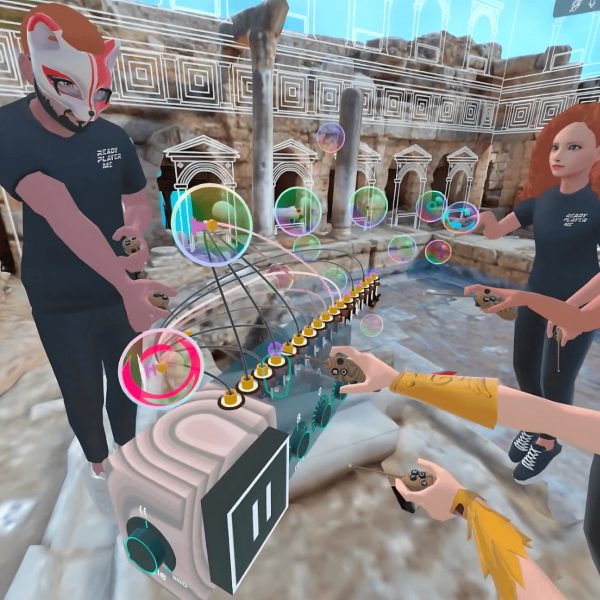
In PatchWorld, patching becomes spatial, embodied, and immediate. You are not only operating a system from outside it, you are literally inside the system you are building. Blocks can be grabbed, connected, arranged, grouped, duplicated, and transformed directly in space. Instruments are not separated from interfaces, and interfaces are not separated from performance. The patch can become the instrument, the stage, the visual system, and the social environment all at once.
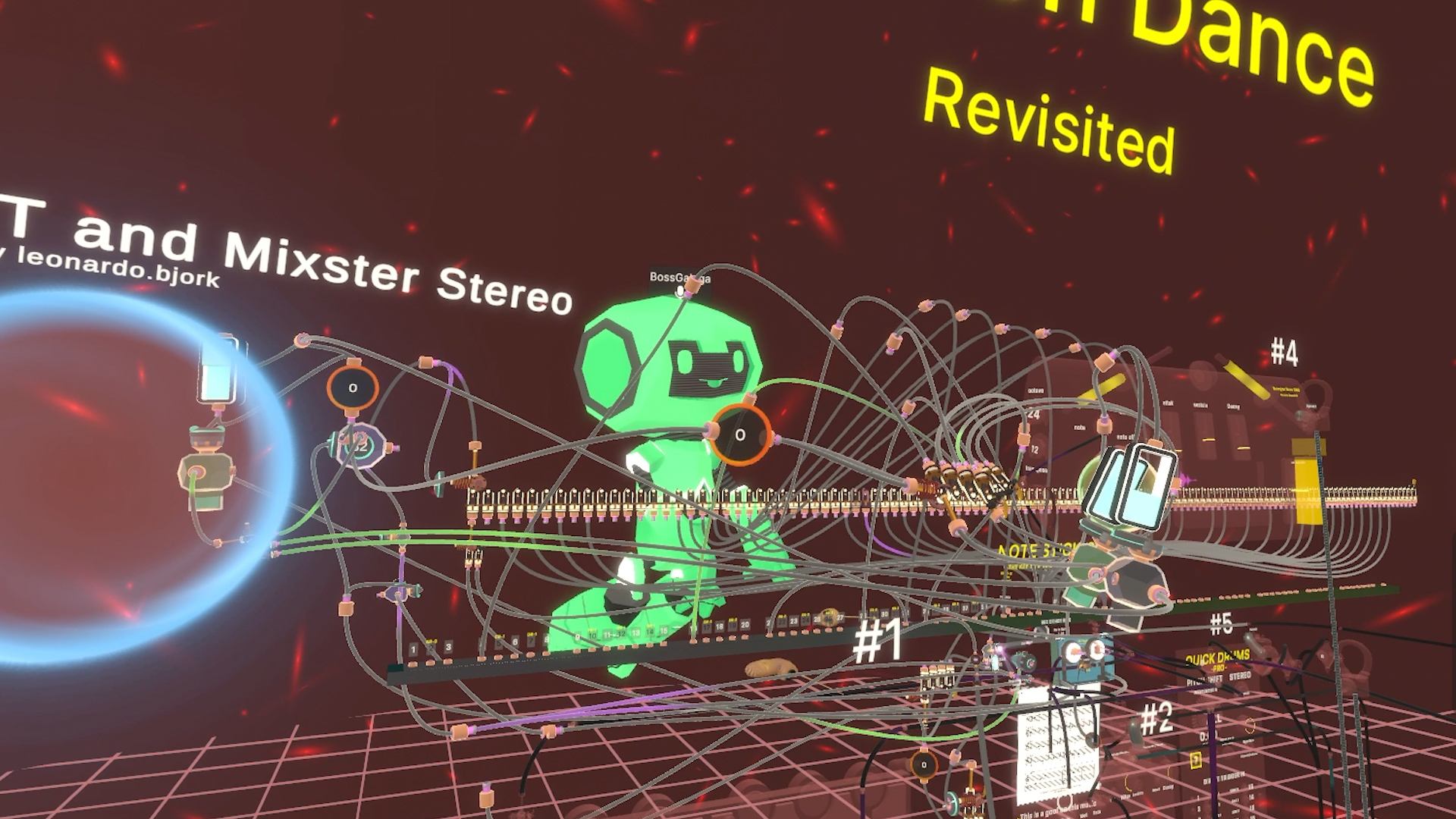
This is where PatchWorld opens a different path from more traditional node-based tools. It combines the tactile logic of modular creation with immersive interaction, mixed reality, and a performative sense of space. It also introduces something that remains rare in electronic music software: real-time collaborative patching and shared worldbuilding.
From visual programming to physical programming
For Gad, one of the most exciting things about patch-based environments such as Pure Data and Max/MSP has always been that they make complex creation hackable, even for people who do not think of themselves as mathematicians or traditional developers.
PatchWorld pushes that feeling further by making patching feel closer to physical programming. Instead of a mouse and keyboard, the user works with hands, bodies, movement, spatial relationships, and the physics of immersive environments. Patching becomes less like abstract interface work and more like a form of virtual soldering, instrument building, or sculpting live systems in space, just like you would do in your studio.
Gad reflected after the event:
“For me, VR builds on visual programming and makes it feel more like physical programming, it feels tangible, clear, and closer to soldering or working with hardware but virtually, and in a more flexible way.”
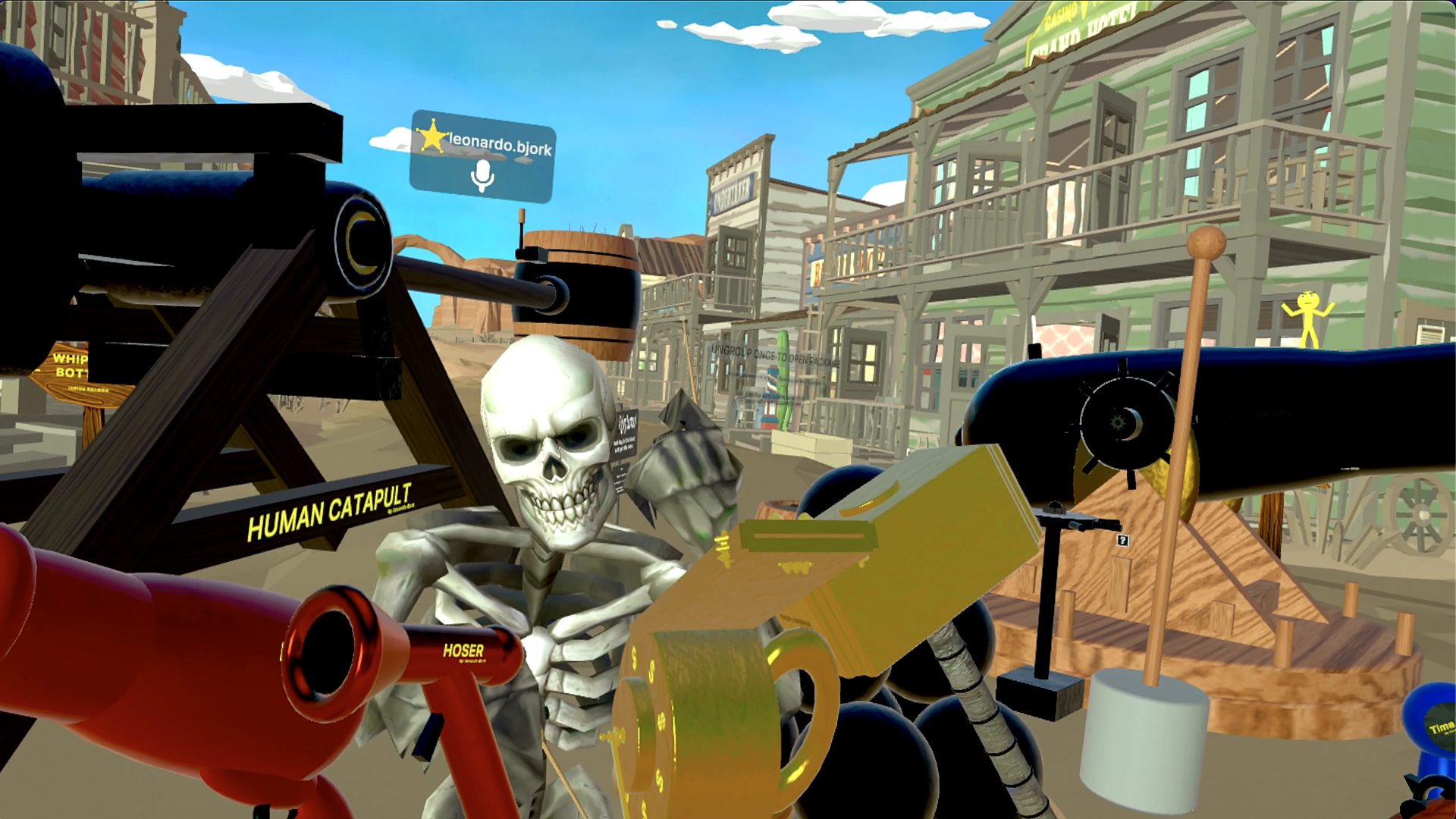
This shift also expands the kinds of interaction that become possible. In PatchWorld, users can build with controller data, headset position, movement through space, relations between objects, real-time visuals, and game-engine physics. Gravity itself can become patchable. Musical triggers can come from collisions, trajectories, gestures, or spatial relationships.
In that sense, PatchWorld does not replace the history of patching. It extends it into a new medium.
A live example: Enrico Benato’s AuraSpace
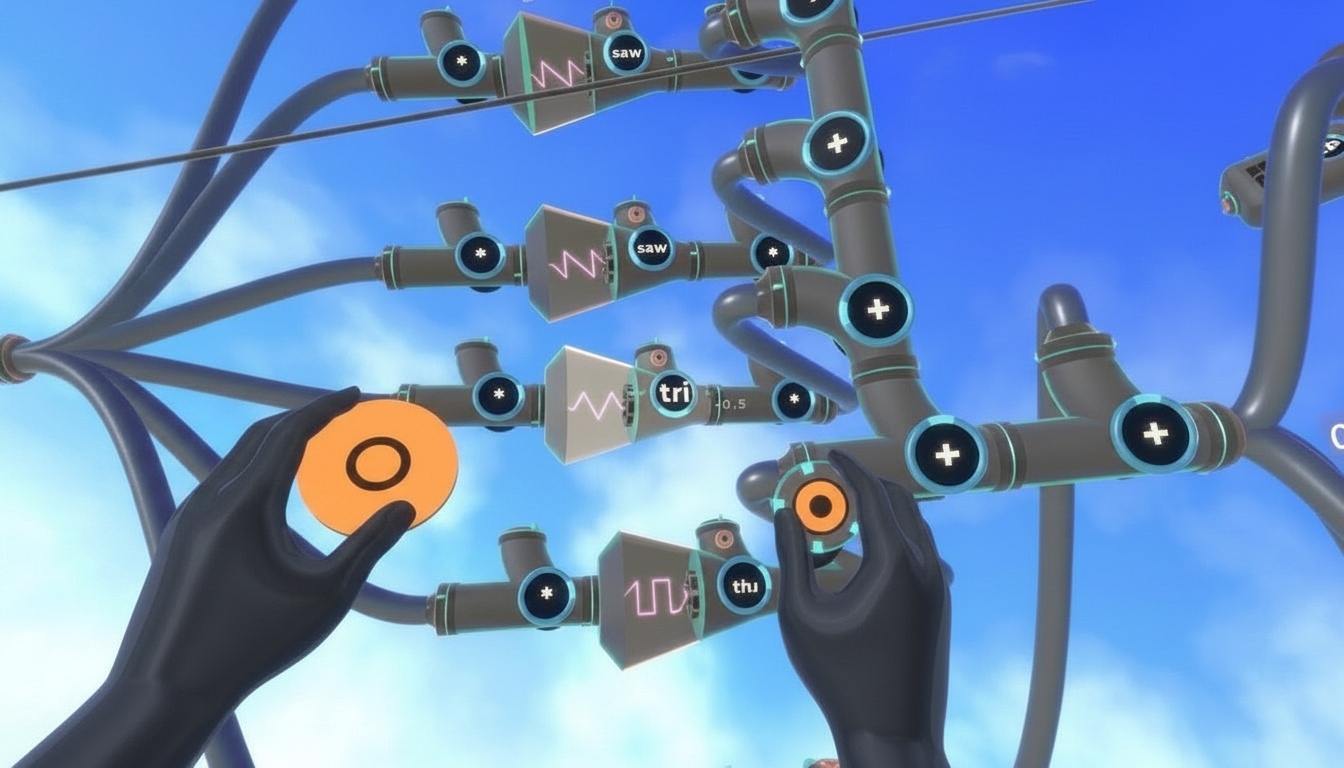
A compelling example presented at PASE came from Enrico Benato, an electronic music composer, live electronics performer, and researcher working with the SaMPL educational and research laboratory. His project, AuraSpace, uses PatchWorld and Pure Data together to explore space itself as a musical interface.
In Enrico’s words, the goal of AuraSpace is to create a performance system in augmented reality where virtual spatial interfaces become sources of sound synthesis. PatchWorld provides the immersive interface layer, while Pure Data powers the synthesis and signal processing. This allows performers to move through virtual instruments placed in real space, using gesture, position, and multidimensional movement as musical expression.
As Enrico described it, PatchWorld becomes the spatial and gestural layer of the system, while Pure Data remains the synthesis engine. The connection between the two allows space, gesture, and movement to become part of musical expression.
“PatchWorld becomes the immersive interface layer, while Pure Data remains the synthesis engine,” Enrico explained. “Together, they allow space, gesture, and movement to become part of musical expression.”
AuraSpace includes a set of custom instruments that turn space into a compositional and performance paradigm:
Corpus XYZ is a timbral cube where spatial movement explores multidimensional sound analysis data.
Keyboard XYZ is a 3D keyboard where hand position shapes timbre and filter relationships.
Screen XYZ is a blob-screen instrument for spatial gesture recording and granular automation.
Euclidean Rhythms maps 2D coordinates to drum sequencing structures.
Together, these instruments suggest a different relationship between interface and sound. Space is not only where the performance happens. It becomes part of the musical system itself.
For Enrico, PatchWorld allows musical expression to be reimagined because a single movement can control many audio parameters at once. Coming from a practice that already involved wearable gestural interfaces, microprocessors, inertial sensors, and collaborations with dance performers, PatchWorld extends his research into what he calls different and alternate worlds, places where gesture becomes poetic for composing between realities.
“Gesture becomes poetic for composing between realities.”
This is exactly the kind of artistic research context where PatchWorld starts to make sense beyond the usual language of VR applications. It is not only a headset experience. It can become a spatial interface layer, a performance environment, and a bridge between physical gesture and digital synthesis.
Watch an improvisation in AuraSpace:
Why this matters for the Pure Data world
For artists already working with Pure Data, Max/MSP, or related modular environments, PatchWorld should not be seen as a replacement. It is better understood as an extension of that ecosystem into immersive space.
As both Gad and Enrico suggest in different ways, PatchWorld becomes especially powerful when it is treated as a place to:
- build new interfaces for sound
- create performative and spatial layers for modular systems
- connect audio, visuals, and movement
- let several people build and experience the same system together
PatchWorld also connects outward through MIDI and OSC, which means it can sit alongside existing experimental workflows rather than forcing people to abandon them.
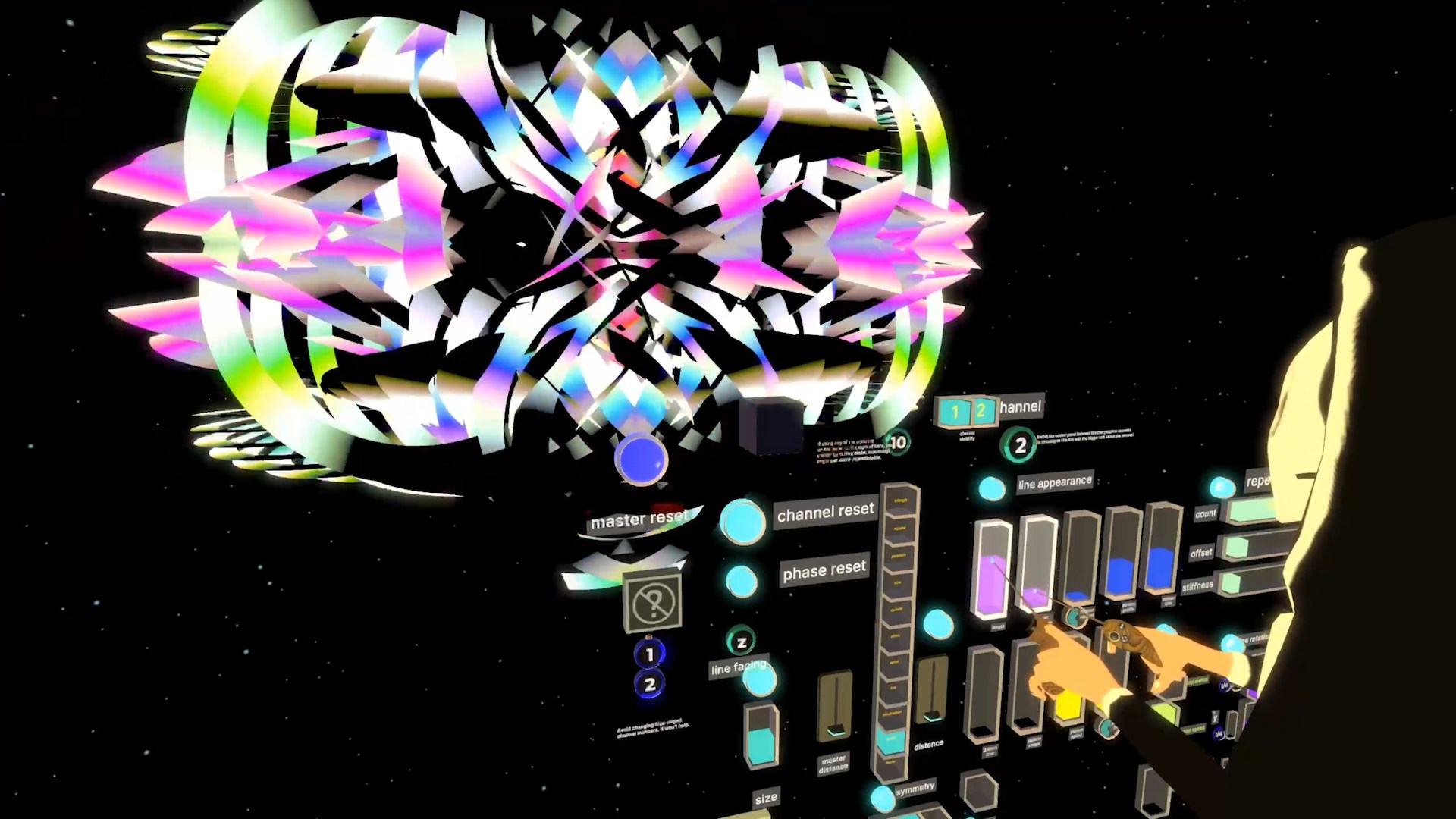
For artists from the Pure Data world, that opens an interesting possibility: using PatchWorld as a new site of expression, embodiment, and distribution while keeping a connection to familiar modular logic.
Patching as a social medium
Another key aspect discussed at PASE is that patching in VR is not only more embodied, it is also more social.
Pure Data has always carried a strong culture of sharing, networked performance, and collaborative experimentation. Through patches, protocols, and distributed setups, artists have used it to connect systems, performers, and machines across space. PatchWorld extends that spirit into an immersive multiplayer environment, where collaboration is not only about exchanging files or connecting remote systems, but about stepping inside the same patch together.
They can inhabit the same patch together, test it, transform it, break it, rebuild it, and let the idea evolve in real time. The experience can feel almost surreal, like a trip: as if the structure of the world itself becomes editable, musical, and responsive.
This is especially important in the context of electronic music, where so much creation has shifted toward isolated production and passive consumption. PatchWorld suggests a different direction: modular thinking, instrument design, audiovisual experimentation, and live communal music-making inside the same medium.
Looking forward
The PASE presentation felt less like a finished statement than the beginning of a conversation with the Pure Data community. The future of patching does not need to stay on a flat screen: it can be spatial, embodied, social, and still playful enough to invite people in.
At PASE in Venice, PatchWorld had the chance to show a glimpse of that.
Further links
If you want to explore the ideas and tools mentioned in this article, here are a few places to start:
- Watch the PASE presentation
- Explore PatchWorld
- Visit the PatchWorld Portal — browse instruments, worlds, devices, and community creations
- Learn more about Pure Data — visit the official Pure Data project
- Discover PASE and SaMPL — learn more about the programme and the research context behind the event
- Follow Enrico Benato’s work